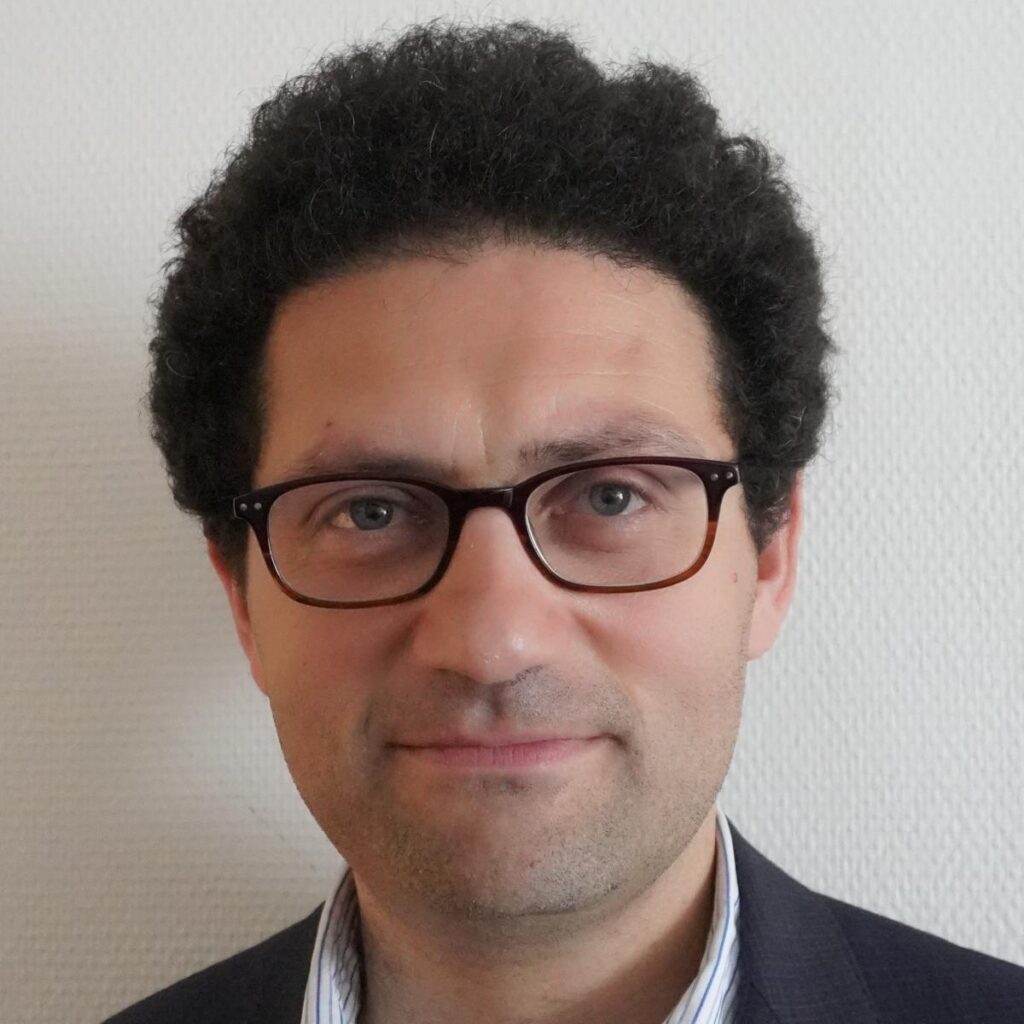
Last March, a new member joined The Beit Project’s Board of Directors. Following the departure of Robert Fohr, Mathias Dreyfuss has agreed to bring his experience to the association. We extend our warm thanks to him for his commitment, as well as to Robert Fohr for his invaluable support over the past years.
A graduate of the EHESS with a PhD in history, Mathias Dreyfuss has been an Associate Professor of Contemporary History at Aix-Marseille University since December 2025. His research focuses on the writing of Jewish history in France, with a particular interest in how this past has been preserved and interpreted as heritage.
After serving for nearly ten years as Head of Education at the Museum of Jewish Art and History in Paris, he went on to hold the same position at the National Museum of Immigration History. There, he also acted as technical curator for the exhibition Jews and Muslims: From Colonial France to the Present Day (curated by Benjamin Stora in collaboration with Karima Dirèche).
From 2021 to 2025, he served as Deputy Interministerial Delegate at the Interministerial Delegation for the Fight against Racism, Antisemitism, and Anti-LGBT Hatred. In this role, he was particularly responsible for overseeing the national action plan to combat racism, antisemitism, and origin-based discrimination (2023–2026), with a focus on educational and memory-related issues.
If you were a place, which one would you be—and why?
As a young adult, I came across Georges Perec’s Species of Spaces. Reading it was a turning point, awakening me to the importance of the emotional bonds that tie us to places—whether intimate ones, like a bed or a bedroom, or more collective spaces.
Having lived in the same city, Paris, until the age of forty, my memories often take me back to my childhood neighborhood and the routes I followed to my primary school on Rue de Picpus (in the 12th arrondissement). It is a street steeped in history: in 1794, during the height of the Reign of Terror, the bodies of those who had been guillotined were transported there and buried at night in a small adjacent cemetery.
But above all, it was a commemorative plaque—rather cryptic, and one whose meaning I only understood thirty years later—that would catch my eye at the intersection of Rue de Picpus and Avenue Saint-Mandé, sometimes drawing me into deep reverie. If I were to be a place, I might be that most ordinary traffic island where children play just below the plaque. It feels like an invitation to look up, to sense what separates us from the lives of those who came before us, and what, quietly and almost invisibly, continues to connect us to them across generations.